
Starting a business does not always mean creating a formal company right away.
Many people begin as sole proprietors without even realizing it. They sell services, take payments, work with clients, launch a small online store, or start a side hustle under their own name. At the beginning, that may feel simple and harmless.
But once money, contracts, customers, vendors, or risk are involved, the business structure starts to matter.
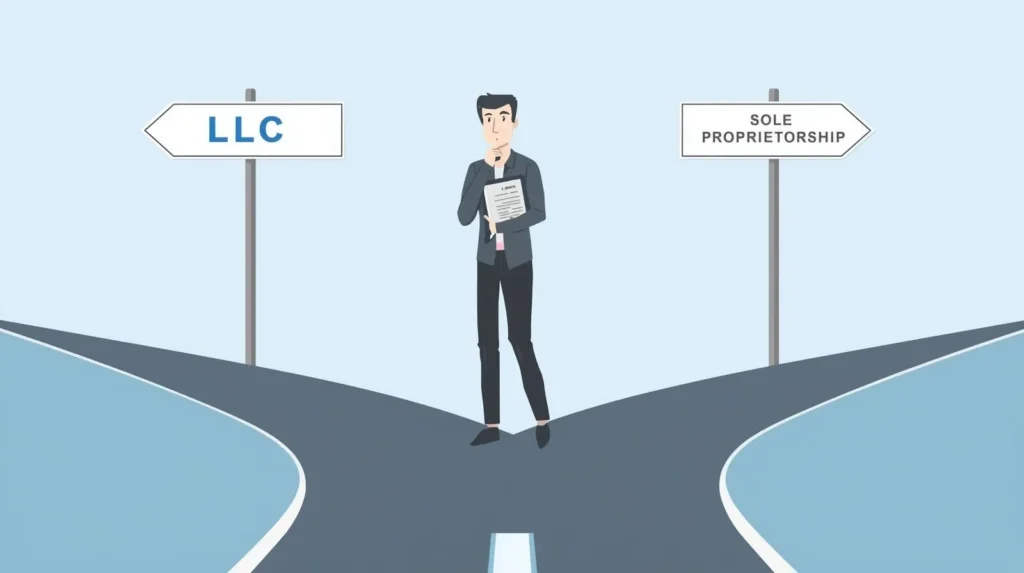
The biggest difference between an LLC and a sole proprietorship is liability protection.
A sole proprietorship is easy to start, but there is no legal wall between you and your business.
An LLC creates a separate legal entity, which can help protect your personal assets if the business faces debt, lawsuits, or legal claims.
That does not mean an LLC protects you from everything. You still need proper records, separate finances, contracts, insurance, and responsible business practices.
But compared with a sole proprietorship, an LLC usually gives business owners a stronger legal foundation.
In this guide, we will explain LLC vs sole proprietorship liability protection, how each structure works, what risks sole proprietors face, when an LLC makes sense, and what you should know before choosing between the two.
What Is a Sole Proprietorship?

A sole proprietorship is the simplest form of business.
If you start doing business by yourself and do not form a legal entity like an LLC or corporation, you are usually operating as a sole proprietor by default.
For example, you may be a sole proprietor if you:
• Sell freelance services under your own name
• Run a small local service business
• Sell products online without forming an LLC
• Work as an independent contractor
• Offer consulting or coaching services
• Get paid directly by clients
• Run a side business without registering a company
A sole proprietorship is easy because there is usually no separate formation filing required at the state level.
You can start quickly.
But that simplicity comes with a major downside: you and the business are legally the same person.
That means business liabilities can become personal liabilities.
What Is an LLC?

An LLC, or Limited Liability Company, is a legal business structure created by filing formation documents with the state.
Unlike a sole proprietorship, an LLC is a separate legal entity.
In simple words, the business is not just “you doing business.” It becomes its own company.
An LLC can own property, sign contracts, open bank accounts, earn income, owe debts, and be sued in its own name.
The main reason business owners form LLCs is liability protection.
If the LLC is properly formed and managed, your personal assets are generally better protected from business debts and lawsuits.
An LLC also gives you flexible tax treatment, a more professional image, and better separation between personal and business finances.
LLC vs Sole Proprietorship: Quick Comparison
| Feature | Sole Proprietorship | LLC |
|---|---|---|
| Legal Entity | No separate legal entity | Separate legal entity |
| Liability Protection | No built-in liability protection | Liability protection when properly maintained |
| Formation | Automatic when you start business alone | Requires state filing |
| Startup Cost | Usually low | State filing fee applies |
| Taxes | Reported on personal return | Flexible tax treatment |
| Business Bank Account | Possible, but less formal | Strongly recommended and easier to structure |
| Business Credibility | Basic | More professional |
| Owner Responsibility | Owner personally responsible | LLC generally responsible for business obligations |
| Best For | Very small, low-risk side businesses | Serious businesses with customers, contracts, or risk |
The Main Difference: Liability Protection

Liability protection is the biggest reason to choose an LLC over a sole proprietorship.
Sole Proprietorship Liability
In a sole proprietorship, there is no legal separation between you and the business.
If the business owes money, you owe money.
If the business gets sued, you may be personally named.
If a customer wins a claim against the business, your personal assets may be at risk.
That can include:
• Personal bank accounts
• Savings
• Car
• Home equity
• Personal property
• Future income
• Other personal assets
This is the biggest weakness of a sole proprietorship.
It is simple, but it gives you very little legal separation.
LLC Liability
An LLC creates a legal separation between the owner and the business.
If the LLC is sued or owes business debt, the claim is usually against the LLC, not the owner personally.
That means your personal assets are generally better protected.
For example, if your LLC signs a contract and later cannot pay, the other party may be limited to pursuing the LLC’s assets, not your personal savings.
This protection is not unlimited, but it is much stronger than operating as a sole proprietor.
Example: How Liability Works in Real Life?
Let’s say you run a small web design business.
You create a website for a client. The client claims your work caused them financial loss and sues the business.
If You Are a Sole Proprietor
The lawsuit may be against you personally because there is no separate business entity.
Your personal bank account and other assets may be exposed if the claim succeeds.
Even if you win, you may still deal with stress, legal costs, and personal risk.
If You Have an LLC
The lawsuit is usually against the LLC, assuming the contract was signed in the LLC’s name and you managed the company properly.
Your personal assets may be better protected.
The LLC’s bank account, business assets, and insurance may be involved, but your personal finances are generally more separate.
This is why structure matters.
What an LLC Protects You From?
An LLC can help protect your personal assets from many business-related liabilities.
This may include:
• Business debts
• Contract disputes
• Vendor claims
• Customer lawsuits
• Commercial lease obligations
• Certain business loans not personally guaranteed
• Claims against the business entity
• Some employee-related business claims
• Business credit obligations
The protection works best when the LLC is properly formed, properly maintained, and clearly used in business dealings.
That means contracts should be signed in the LLC’s name, business money should stay separate, and the company should follow state requirements.
What an LLC Does Not Protect You From?
An LLC is powerful, but it is not magic.
It does not protect you from everything.
You may still be personally responsible in certain situations.
1. Personal Guarantees
If you personally guarantee a loan, lease, credit card, or vendor agreement, you may still be personally liable.
Many banks and landlords require personal guarantees from small business owners.
In that case, the LLC does not remove your personal promise to pay.
2. Personal Wrongdoing
If you personally commit fraud, negligence, or illegal acts, the LLC may not protect you.
For example, if you personally injure someone through your own actions or intentionally mislead a customer, you may still face personal liability.
3. Mixing Personal and Business Money
If you treat the LLC like your personal wallet, you weaken the separation between you and the company.
This is called commingling funds.
Examples include:
• Paying personal bills from the LLC account
• Depositing business income into your personal account
• Using business funds for personal expenses without proper records
• Not keeping clean accounting
If the separation is ignored, liability protection can become weaker.
4. Unpaid Payroll Taxes or Certain Tax Debts
Some tax obligations can create personal responsibility for owners or responsible parties.
This is especially important if you have employees.
5. Lack of Insurance
An LLC protects against certain legal and financial risks, but it does not replace insurance.
If your business has real operational risk, you may still need general liability insurance, professional liability insurance, workers’ compensation, commercial auto insurance, or other coverage.
What Is Piercing the Corporate Veil?
“Piercing the corporate veil” is a legal concept where a court ignores the separation between the business and the owner.
If that happens, the owner may become personally liable for business debts or claims.
This can happen if the owner does not treat the LLC like a real separate company.
Common Reasons Liability Protection Can Be Weakened
Courts may look at factors such as:
• Mixing personal and business funds
• Undercapitalizing the business
• Using the LLC for fraud
• Failing to keep business records
• Signing contracts personally instead of through the LLC
• Not following state requirements
• Treating the LLC like an alter ego of the owner
This is why forming the LLC is only step one.
You also need to run it properly.
How Sole Proprietorship Taxes Work?
A sole proprietorship is simple for taxes.
Business income and expenses are usually reported on the owner’s personal tax return.
The owner may report business profit or loss on Schedule C.
The net profit is generally subject to income tax and self-employment tax.
This is one reason sole proprietorships are easy for beginners.
There is no separate business tax return for the sole proprietorship in many cases.
But simple taxes do not solve the liability problem.
How LLC Taxes Work?
An LLC has flexible tax treatment.
A single-member LLC is usually taxed like a sole proprietorship by default.
A multi-member LLC is usually taxed like a partnership by default.
An LLC can also elect S-Corp or C-Corp taxation if it qualifies.
Single-Member LLC Taxation
A single-member LLC is usually treated as a disregarded entity by default.
That means business income and expenses are reported on the owner’s personal tax return, similar to a sole proprietorship.
So for federal tax purposes, a single-member LLC can feel similar to a sole proprietorship.
But legally, the LLC is still separate from the owner.
That legal separation is the key benefit.
Multi-Member LLC Taxation
A multi-member LLC is usually taxed as a partnership by default.
The LLC files an informational return, and each member receives a Schedule K-1 showing their share of profits or losses.
S-Corp Election
Some LLCs elect S-Corp taxation to potentially reduce self-employment tax.
This may make sense when the business has steady profit, but it adds payroll, tax filing, and compliance requirements.
For many beginners, default taxation is simpler at the start.
LLC vs Sole Proprietorship: Tax Difference
For a single-owner business, taxes may feel similar whether you operate as a sole proprietor or a single-member LLC.
Both may report business income on the owner’s personal tax return by default.
The key difference is not always taxes.
The key difference is legal protection.
A sole proprietorship and single-member LLC may have similar federal tax treatment by default, but they are not the same legally.
The LLC creates a separate legal entity.
The sole proprietorship does not.
Business Credibility Difference
An LLC can make your business look more serious.
Clients, vendors, banks, and partners may view an LLC as more established than a sole proprietorship.
For example, compare these two names:
• John Smith
• Smith Digital Consulting LLC
The LLC name looks more like a real business.
This can help when signing contracts, applying for business accounts, setting up payment processors, working with vendors, or pitching clients.
A sole proprietorship can still be professional, but an LLC usually gives a stronger business image.
Banking Difference
A sole proprietor can often open a business bank account, especially with a DBA if needed.
But an LLC usually creates a cleaner banking setup.
Most banks will ask for:
• LLC formation document
• EIN
• Operating agreement
• Personal ID
• Business address
A separate LLC bank account helps keep business and personal finances separate.
This is important for liability protection, bookkeeping, taxes, and professionalism.
For sole proprietors, banking may be simpler, but the lack of legal separation remains.
DBA vs LLC: Are They the Same?
No.
A DBA and an LLC are not the same thing.
A DBA, or “doing business as” name, lets you operate under a business name different from your personal legal name.
For example, if your name is Sarah Miller and you operate as “Miller Creative Studio,” you may register that name as a DBA.
But a DBA does not create liability protection.
It is only a name registration.
An LLC creates a separate legal entity.
That is a much bigger difference.
DBA Example
Sarah Miller operates as “Miller Creative Studio” with a DBA.
Legally, Sarah is still the business.
LLC Example
Sarah forms “Miller Creative Studio LLC.”
Now the LLC is a separate legal entity.
This can help protect Sarah’s personal assets if the business faces claims.
Cost Difference
A sole proprietorship is usually cheaper to start.
You may not need to pay state formation fees unless you register a DBA, get licenses, or apply for permits.
An LLC costs more because you usually need to pay a state filing fee.
LLC costs may include:
• State formation fee
• Registered agent service
• Annual report fee
• Franchise tax or state renewal fee
• Operating agreement cost, if you use a service
• Business license fees
• Formation service fee, if used
The cost varies by state.
Some states are very affordable. Others charge hundreds of dollars to form and maintain an LLC.
Is the LLC Cost Worth It?
For many businesses, yes.
If your business has customers, contracts, payments, employees, debt, risk, or meaningful income, the liability protection and credibility may be worth the cost.
For a tiny hobby with no real risk or income, a sole proprietorship may be enough at the beginning.
Compliance Difference
A sole proprietorship has fewer formal requirements.
An LLC usually has more ongoing responsibilities.
Sole Proprietorship Compliance
A sole proprietor may need:
• Business license
• DBA registration, if using a business name
• Tax registration
• Sales tax permit, if applicable
• Local permits
There is usually no annual entity report because there is no separate entity.
LLC Compliance
An LLC may need:
• Formation filing
• Registered agent
• Annual report
• Franchise tax or renewal fee
• Operating agreement
• Business licenses
• Tax registration
• Separate bank account
• State compliance filings
The added compliance is the tradeoff for liability protection.
When a Sole Proprietorship May Be Enough?
A sole proprietorship may be fine if your business is very small, low-risk, and still in the testing phase.
It may work if:
• You are testing a business idea
• You have no major contracts
• You have very little revenue
• Your business has low legal risk
• You have no employees
• You do not sign leases or loans
• You are not ready to pay LLC fees
• You are doing hobby-level work
For example, if you are testing a small side hustle with no meaningful risk, you may begin as a sole proprietor.
But as the business grows, forming an LLC becomes more important.
When Does an LLC Make More Sense?

An LLC may be the better choice if your business has real activity, risk, or income.
You should consider an LLC if:
• You work with clients
• You sign contracts
• You sell products
• You have business debt
• You rent office or commercial space
• You hire workers or contractors
• You operate online with customers
• You want to protect personal assets
• You want a professional business identity
• You want better separation between business and personal finances
• Your business income is becoming consistent
If people pay you for products or services, an LLC is usually worth considering.
Example: Freelancer
A freelance designer starts by doing small projects for friends.
At first, a sole proprietorship may be enough.
But once the designer works with paying clients, signs contracts, collects thousands of dollars, and handles client deadlines, an LLC becomes more useful.
If a client sues over a project dispute, an LLC can help separate business liability from personal assets.
The freelancer should also use contracts and business insurance.
Example: Ecommerce Seller
An ecommerce seller starts selling products online.
If a customer claims a product caused harm, the seller could face legal risk.
A sole proprietorship gives no legal separation.
An LLC may help protect personal assets from business claims, assuming the business is properly managed.
For ecommerce sellers, an LLC plus product liability insurance can be a smart setup.
Example: Real Estate Investor
A real estate investor owns a rental property.
Rental properties can create liability risk because tenants, guests, repairs, leases, and property conditions are involved.
Operating as a sole proprietor may expose personal assets.
An LLC can help separate the rental business from the owner personally.
Many real estate investors use LLCs for this reason, though lending, insurance, and property transfer rules should be reviewed carefully.
Example: Local Service Business
A local cleaning business, landscaping company, handyman service, or contractor may face customer property damage claims, injury claims, or contract disputes.
A sole proprietorship exposes the owner personally.
An LLC can provide a stronger legal structure.
For service businesses, liability insurance is also important because accidents can happen even when the business is careful.
Does an LLC Replace Business Insurance?
No.
An LLC does not replace business insurance.
An LLC can help protect personal assets from certain business liabilities, but insurance helps pay claims, legal defense costs, settlements, property damage, injuries, and other risks.
Depending on your business, you may need:
• General liability insurance
• Professional liability insurance
• Product liability insurance
• Workers’ compensation insurance
• Commercial auto insurance
• Cyber liability insurance
• Property insurance
The strongest setup is often an LLC plus appropriate insurance.
Can You Start as a Sole Proprietor and Later Form an LLC?
Yes.
Many business owners start as sole proprietors and later form an LLC when the business grows.
This can be a practical path.
You may start as a sole proprietor while testing your idea, then form an LLC once you have regular customers, contracts, revenue, or legal risk.
When you switch, you may need to:
• File LLC formation documents
• Get an EIN
• Open a business bank account
• Move contracts to the LLC
• Update invoices and payment accounts
• Get licenses under the LLC name
• Notify clients or vendors
• Create an operating agreement
The sooner your business has real risk, the sooner you should consider forming an LLC.
How to Maintain LLC Liability Protection?
Forming an LLC is not enough.
You need to maintain the separation between you and the company.
1. Open a Business Bank Account
Keep LLC money separate from personal money.
Do not mix funds.
2. Sign Contracts in the LLC Name
Your contracts should name the LLC as the party, not you personally.
For example:
“Smith Consulting LLC”
Not just:
“John Smith”
3. Keep Basic Records
Save formation documents, operating agreement, contracts, invoices, tax records, and major decisions.
4. File Annual Reports
If your state requires annual reports, file them on time.
5. Maintain a Registered Agent
Keep your registered agent information current.
6. Use Proper Business Licenses
An LLC does not replace licenses or permits.
Stay compliant with local and industry rules.
7. Avoid Personal Guarantees When Possible
If you personally guarantee a debt, you may still be personally liable.
Understand what you are signing.
LLC vs Sole Proprietorship: Pros and Cons
Sole Proprietorship Pros and Cons
Pros
• Easy to start
• Low startup cost
• Simple tax reporting
• Full control
• Fewer state filings
• Good for testing a small idea
• No separate entity maintenance
Cons
• No built-in liability protection
• Owner is personally responsible for business debts
• Less professional image
• Harder to separate business and personal finances
• Business may seem less credible
• No separate legal entity
• Personal assets may be exposed
A sole proprietorship is simple, but it is risky once the business becomes serious.
LLC Pros and Cons
Pros
• Personal liability protection
• Separate legal entity
• More professional image
• Flexible tax options
• Better business banking structure
• Good for single-owner and multi-owner businesses
• Helps separate business and personal finances
• Useful for growing businesses
Cons
• State filing fees
• Annual report or renewal fees in many states
• Registered agent requirement
• More paperwork than a sole proprietorship
• Must maintain separation properly
• Does not replace insurance
• Some tax and compliance rules may apply
An LLC costs more than a sole proprietorship, but it offers stronger protection and credibility.
Which One Is Better for Liability Protection?
An LLC is better for liability protection.
A sole proprietorship does not create a separate legal entity.
That means the owner and business are legally the same.
An LLC creates a separate company, which can help protect personal assets from business liabilities.
This is the main reason many business owners upgrade from sole proprietorship to LLC.
However, LLC protection works best only when you manage the company properly.
If you mix funds, commit fraud, ignore legal requirements, or personally guarantee debts, your protection can be limited.
Which One Is Better for Taxes?
For a single-owner business, the default federal tax treatment may be similar.
A sole proprietor and a single-member LLC both often report business income on the owner’s personal tax return.
So taxes may not be the main reason to choose one over the other at the beginning.
The bigger reason is liability protection.
That said, LLCs offer more tax flexibility over time because they may elect S-Corp or C-Corp taxation if eligible.
A sole proprietorship does not offer the same structural flexibility unless you form an entity.
Which One Is Better for Beginners?
A sole proprietorship is easier for complete beginners who are only testing an idea.
An LLC is better for beginners who are serious about building a real business.
Choose a sole proprietorship if:
• You are testing a small idea
• The risk is very low
• You have little or no revenue
• You are not ready for formation fees
• You do not sign major contracts
Choose an LLC if:
• You have paying customers
• You sign contracts
• You sell products or services
• Your business has risk
• You want personal asset protection
• You want a professional business identity
• You want cleaner business banking
For most serious business owners, an LLC is the better long-term structure.
Common Mistakes to Avoid
1. Thinking a DBA Protects You
A DBA is only a business name.
It does not create liability protection.
2. Waiting Too Long to Form an LLC
If your business already has customers, contracts, and income, waiting too long can increase personal risk.
3. Forming an LLC but Mixing Money
Do not use one account for everything.
Open a business bank account.
4. Signing Contracts Personally
If you have an LLC, contracts should generally be signed in the LLC’s name.
5. Ignoring Insurance
An LLC helps, but insurance is still important.
6. Assuming an LLC Protects Against Everything
It does not.
Personal guarantees, fraud, personal negligence, and certain tax issues can still create personal liability.
7. Not Keeping the LLC in Good Standing
File annual reports, maintain your registered agent, and pay required state fees.
Final Verdict: LLC vs Sole Proprietorship
A sole proprietorship is simple, cheap, and easy to start.
But it does not give you built-in liability protection.
That means if the business gets sued or owes money, your personal assets may be at risk.
An LLC costs more and requires state filing, but it creates a separate legal entity. That separation can help protect your personal assets from business debts and lawsuits when the LLC is properly managed.
If you are only testing a low-risk idea, a sole proprietorship may be enough for now.
But if you have customers, contracts, revenue, business debt, products, services, employees, or real risk, an LLC is usually the smarter structure.
The simplest way to think about it is this:
A sole proprietorship is easy to start.
An LLC is better for protection.
If you are serious about building a business, the LLC usually gives you a stronger foundation.